
Today, I welcome a fellow Tudor fan and author, Dean Hamilton, to share his thoughts on research, writing, and his favourite books.
Tell us a little about yourself.
First, I just want to say thank you for the opportunity to participate in your blog. We seem to share a mutual obsession with the Tudor era.
By way of background, my name is Dean Hamilton. I currently pursue my writing career in Toronto, Ontario, Canada. I have three degrees (BA, MA & MBA), read an unhealthy amount of history flung across a range of eras. I work as a marketing professional by day and prowl the imaginary alleyways of the Elizabethan era in my off-hours. I have a very large dog that keeps me walking multiple times a day in all types of weather, which provides great time for story plotting.
How did you get into writing?
I’ve been writing for years – blogs, book review sites, articles, marketing copy mainly but fiction was relatively new to me. When I turned 40 years old, I decided I should plan out my mid-life crisis. Being unable to afford a Ferrari, I decided to write a book, and that book was a fictional dive into the Elizabethan era, Shakespeare and the history of London’s play-acting troupes.
What era do you write about and what drew you to that time period(s)?
My book series – three stand-alone mystery/thrillers and a novella – are all set in the Elizabethan era, from 1574-1579. They follow Christopher Tyburn, ex-soldier turned play-actor, as he uncovers mystery and mayhem in the back-alleys of London.
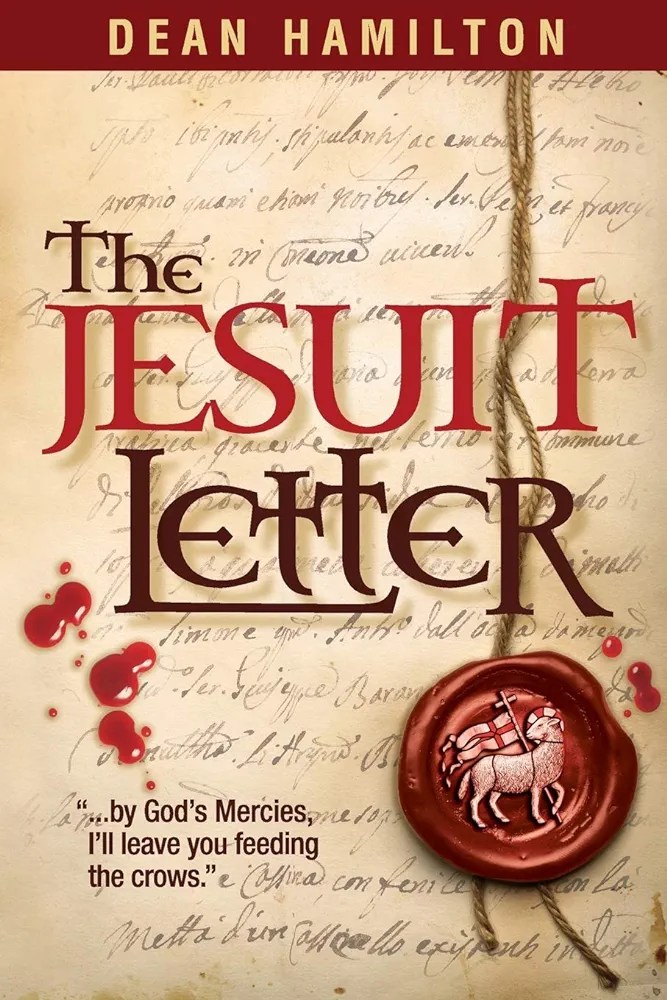
The first book, THE JESUIT LETTER was released in 2015, followed by a novella BLACK DOG IN 2016, and the sequel THIEVES’ CASTLE in 2019. The third book in the series, SORCERER STREET, is in editing and currently being shopped around to potential book agents. It will hopefully be out in 2024/25.

Can you tell us a little bit about your most recent book?
The most recent published book is THIEVES’ CASTLE, set in London in 1576. It is the sequel THE JESUIT LETTER but is fine as a stand-alone work.
Kit Tyburn, ex-soldier turned play-actor and part-time intelligencer for the Queen’s spymaster Francis Walsingham, is back in London and adrift. Penniless, cut loose from both his playing troupe and his mercurial employer, Tyburn is hired to track down a missing gold-seller who has vanished, along with the monies needed for the completion of London’s first permanent theatre.
But London’s dark and fetid back-alleys hide deadly secrets, as Tyburn uncovers a more treacherous game – a war between two noble houses that pulls him into a murderous conflict on the streets, a deadly Spanish conspiracy and a twisted thief-lord chasing her vengeance.

Where can people order your book(s)?
They are available on Amazon in both print and digital formats.
Are you working on something at the moment? If so, can you spill the beans a little?
Well, now that I’ve finished the third book in the Tyburn Folios, I’ve decided to venture into a somewhat different direction. The first chapter of the new book project is done but the research is still ongoing. It’s a new era for me, venturing away from the Elizabethan age & setting out on a new venture & new characters – a bloody, hopelessly cinematic, wanderjahr of a story of someone adrift.
And yes, it involves Vikings…
I can share the opening line: “Death came with the ebbing tide.”
How do you go about your research?
A lot of reading, a deep dive into the historical record, and digging into original sources where feasible. The web is a terrific tool that opens up a broad range of research sources from maps to currencies to clothing styles, with the caveat that you need to constantly check your sources and ensure they are solid. In historical fiction, you want to make a realistic world that reflects the historical reality of the times. Inconsistencies and inaccuracies will pull the reader out of the reality of the story and destroy that illusion of the setting that is so fundamental to the story.
Do you have a favourite historical source?
One of the sources that I used constantly when writing both THIEVES’ CASTLE and the yet to be published SORCERER STREET was the Civitas Londinum, the “Agas” map of London, which was a woodcut print map of London dated to the 1560s. I used both a high-res digital copy of the map, as well as a print book copy that I purchased online and cost a ridiculous amount.
Naturally, after I had made that purchase I found the wonderful Map of Early Modern London Project site (https://mapoflondon.uvic.ca/) run by the University of Victoria which has an interactive, highly detailed and appended version of the map and everything on it. For anyone interested in the Tudor age, I highly recommend this fabulous resource. It helped me locate and track all the movement and action of my plot and characters across the kaleidoscope cityscape of Elizabethan London.
If you could give one piece of advice to aspiring authors, what would it be?
Persistence and editors. Persistence because until you have gone through the process of putting words writing a book, you may not realize how difficult it can be. Persistence is your friend. Just keep putting words on paper, even if it is just a few at a time. Eventually those few words become a pile, then a bigger pile, then eventually a book.
Editors are also critical. A good editor will tighten your prose, sharpen your writing, question your assumptions. You need to look past the sea of red ink that will follow an editor’s pass through your document, and look instead for all the benefits and improvements they leave in their wake. Find a good editor you can work with, it will make you better.
Can you tell us your favourite fiction and favourite non-fiction book?
I’m a huge fan of historical fiction and mysteries. Bernard Cornwell books are all must reads for me. I also like a good detective story, particularly with a unique setting that the author brings to life. Tony Hillerman’s Navajo mystery series and Martin Cruz Smith’s Arkardy Renko series are good examples. I’m currently working my way through Adrian Mckinty’s The Detective Up Late, a series set in the Troubles of Northern Ireland.
For non-fiction, it is mostly history with a smattering of current events. Medieval and Renaissance history is a favorite (as is the Tudor era, of which I have far too many books…). Most recently I finished Children of Ash and Elm by Neil Price, which is a superlative look at the history of the Vikings.


I have a website (infrequently updated) at http://tyburntree.blogspot.com/
You can also follow me on Twitter (not going to call it X) at @Tyburn__Tree or Facebook
It has been an absolute pleasure to host Dean! Anyone else really intrigued by that first line of the work in progress?
I hope you’ve enjoyed the guest post, thank you to Dean for joining me!


 Amy McElroy