
I am delighted to welcome author Fiona Forsyth to my blog today. Fiona has kindly allowed me to ask about her writing and published works.
Tell us a little about yourself.
I can’t remember a time when I didn’t love reading about the ancient world, through myths then history. I read Classics at Oxford, then taught at The Manchester Grammar School for 25 years. Now I write novels set in ancient Rome.
How did you get into writing?
Several years ago, my husband was offered a job in Qatar. It was a great opportunity so we upped sticks and went, but jobs teaching Latin were thin on the ground. For the first time in my adult life, I was unemployed! I rescued animals, became a prison visitor and started writing. I’d had the idea for a novel hanging around for many years and now was my chance to get it down onto paper. I never looked back.

What era do you write about and what drew you to that time period(s)?
I write about Rome in the first centuries BCE/CE. It’s a time of political upheaval with some huge characters dominating, and I find the rapid changes and the descent into war very thought-provoking. Later on, as Augustus establishes himself as first Emperor, we see how he manages this huge and chaotic mass of people and does so successfully (I had to say that through gritted teeth, I hate Augustus!). As well as these Very Important People, we do get glimpses through the evidence – which is quite good comparatively speaking – of the unknown characters, the people who maybe aren’t quite so important. And I especially love to see the mothers, sisters, wives and daughters, who rarely have a voice of their own.
Having written about education in the Tudor era, I’m keen to know what you have discovered about education in the era you cover. Can you tell us a bit about that?
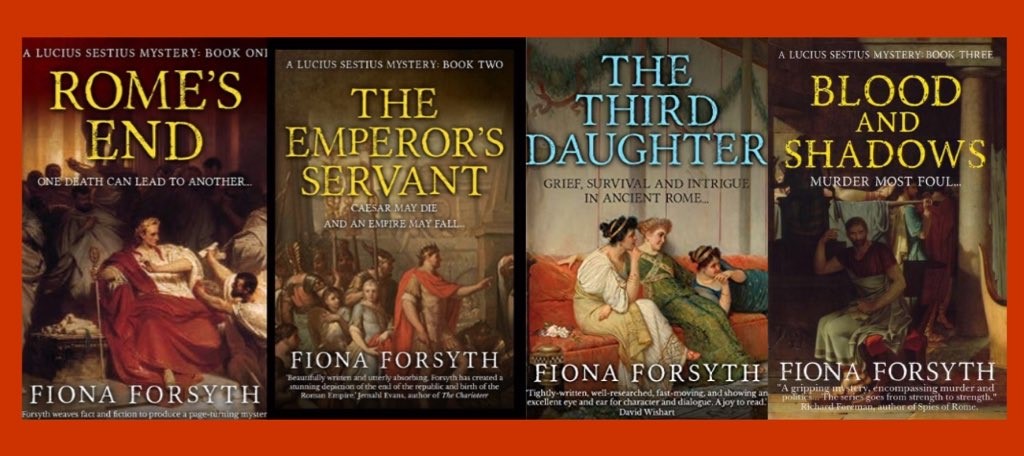
For one book, The Third Daughter, I was researching the women of an upper-class family and learned quite a bit about women and education – and of course made the unsurprising discovery that a woman from a rich family might well be almost as well-educated as her brother! A girl might have shared her brothers’ tutors, and so learned to read and speak Greek as well as Latin, and study literature in both languages. Given that marriage and child-rearing were seen as the main aims of a woman’s life, running a large household would have also been an important part of her education. The Romans were keen on women being able to spin and weave, it gets mentioned on tombstones a lot: “lanam fecit, she made wool.” For the lower classes, we know far less, except that schooling seems to have been in the reach of the middle classes and that it was acceptable for girls to participate in the primary tier of school, reading and writing. But for my latest book, I looked at the eastern Mediterranean, with its many Greek-founded cities and found evidence of free schools being set up by public benefactors – and set up for boys and girls. It is impossible to give you numbers, but we can be cautiously optimistic that there were some educated women wherever you went in the Roman Empire.
Can you tell us a little bit about your most recent book?
I’ve just finished “Poetic Justice”, and with a bit of luck it will be out in December of this year. It is the first in a series about the Roman poet Ovid. He is interesting because he wrote about love and sex and mythology, and shocked people. He was exiled to the shores of the Black Sea in 8BCE, and we have only a hazy idea why, though probably shocking people didn’t help. I’m really enjoying exploring that mystery while portraying an absolutely miserable and maybe not very sympathetic poet. I’m trying to persuade my publisher to let me call the series “The Black Sea Scrolls”.
Where can people order your book(s)?
My Amazon Author page is the best place, especially if you are an e-reader fan, like me: Amazon
If people want signed copies, then they are very welcome to contact me through my website (see below)
Are you working on something at the moment? If so, can you spill the beans a little?
I’ve moved straight onto book two in the Ovid series, and I’m focussing on the death of Augustus. I found this an interesting moment in Roman history because although we look back and see a seamless transition of power from Augustus to his stepson Tiberius, for the Romans it was a lot more precarious because nothing like this had happened before. Augustus had ruled Rome for decades, he had been in the limelight since the age of nineteen and sole ruler for forty five years. Most of the population he ruled would not be able to remember a time when he wasn’t around!

How do you go about your research?
I usually start with an idea that has arisen through research for a previous book. Then it’s a question of reading a lot of books, a lot of articles. I may have studied Classics for most of my life, but I still have to find out details like what Roman towels were made of, and did they eat oranges. I have subscriptions to JSTOR and Academia, thank goodness for the Internet! I usually know very quickly whether or not the idea will work as a story. Of course once I start fleshing out the actual story, most of the research never gets used, but I believe firmly that because of all the work you’ve done there is a confidence to your story. And readers pick up on that, I think. It makes them feel they can trust you to get the facts as accurate as is possible, given the limitations of the evidence.
Do you have a favourite historical source?
Without a doubt, Cicero. My favourite Roman ever! A philosopher, a politician, an orator, a letter writer – he knew everybody, he had opinions about everybody, he lived through the Ides of March and the rise of Augustus. He was killed on the order of Mark Antony, and I may well have shed tears over him. What he has left us is the most important body of evidence for the crucial period when Julius Caesar was around, but he also comes out of his writings himself as a fully-rounded and flawed human being. He did not know that his letters would be published after his death so he writes freely – and I defy any historian to say they don’t love reading someone else’s letters!
If you could give one piece of advice to aspiring authors, what would it be?
The moment you write, you are a writer: and whether you self-publish or not doesn’t matter.
Can you tell us your favourite fiction and favourite non-fiction book?
Just one?? You are kidding, right? Seriously, the answer changes every time I get asked. I am a voracious reader, between 100 and 200 books a year, and today my favourite book is “The Fever of the World” by Phil Rickman. It’s the latest in his Merrily Watkins mystery series, and he tackles Covid head-on, which I think is a brave thing for an author to do. In non-fiction, I’ve been impressed by Mo Moulton’s “Mutual Admiration Society” which looks at the friendship group of Dorothy L. Sayers at my old college, Somerville. Those post-WW1 women were ground-breakers.
Fiona’s latest book is due to be released in the first week of December, just in time for Christmas!
If you’d like to know more about Fiona, feel free to use the below links

Thank you so much for joining me Fiona, it has been a pleasure to host you.
 Amy McElroy